Generative Artificial Intelligence (genAI)
- AI in development - A topic of great importance and dynamics
- Full responsibility for the AI result, but also the area of application for the developer
- Support for decision-making on the use of AI and AI tools
- SAP AI roadmaps and tools for development
- Support for ABAP Development Through Alternative AI Tools
- Additional Use Cases for Generative AI in Software Development
- AI development on the SAP BTP beyond ABAP
- Summary (AI-assisted)
AI in development - A topic of great importance and dynamics
Generative AI (hereinafter referred to simply as AI) is currently the dominant topic that can no longer be ignored in SAP development. Products and solutions such as ChatGPT, Microsoft Copilot, Google Gemini, and, of course, SAP’s own Joule are being discussed everywhere and are finding (or will soon find) practical applications in numerous solutions. These technologies are also being used in software development, and AI-assisted capabilities are now available even for ABAP development.
The pace of innovation in this field is extremely rapid. New features and capabilities are becoming available in increasingly short cycles, and the quality of the results continues to improve. As a result, it is difficult to make reliable predictions about developments over the coming weeks—not just years.
A prominent example is the recently announced integration capability for MCP servers (including support for SAP documentation and ABAP contexts). While the potential appears significant, its practical implications are still somewhat difficult to assess. Vibe Coding was also surprisingly well represented at SAP TechEd 2025 - another glimpse into a possible future (also for ABAP?).
Despite the uncertainties, this chapter aims to provide guidance for evaluating the use and application of AI in SAP software development, based on the current state of technology as of SAP TechEd 2025. For this reason, we do not attempt to cover every available software solution, nor do we go into exhaustive detail. Instead, this chapter serves as a practical guide, offering general recommendations and highlighting potential use cases and application scenarios.
AI provides tools that help developers create better software more quickly. Although AI is evolving at a rapid pace, it is unlikely to replace human developers. A solid understanding of modern software development remains essential, even when AI tools are used. AI can support developers throughout the various phases of the software development lifecycle. The following examples illustrate areas in which the use of AI can improve efficiency and productivity.
Full responsibility for the AI result, but also the area of application for the developer
Before discussing specific use cases, there are several fundamental aspects that we, as the authors, would like to emphasize.
Based on the current state of knowledge, we are firmly convinced that AI will not replace human developers. A solid foundation in modern software development remains essential, even when AI tools are available. AI can support developers throughout various phases of the software development lifecycle. In later chapters, we will present concrete examples and scenarios that demonstrate how AI can improve efficiency in specific development tasks.
Another important aspect concerns the practical use of AI assistance by developers. Programming and software development are complex disciplines. Even after years—or decades—of experience, there is hardly a day when there is nothing new to learn. Whether a developer’s primary focus is implementation, architecture, or design, the approach and choice of tools used to solve a problem are highly individual. In other words, every (ABAP) developer has personal preferences and applies their own methods and experience when developing and analyzing software.
Why is this important? AI adoption is unlikely to succeed if it is introduced with the expectation that every developer must use it in order to achieve a predefined efficiency gain of xy % (or, even worse, if such gains are assumed in project planning). Most developers will understandably resist being forced into a specific way of working. A more effective approach is to raise awareness of the new possibilities, demonstrate meaningful use cases, and show how AI can support developers in their daily work. AI will only become truly relevant in a developer’s day-to-day activities if the developer is personally convinced of its benefits and recognizes its value.
Closely related to this point is a final aspect that deserves special attention: responsibility. When a developer uses AI to generate something like code, unit tests, RAP objects, etc., the responsibility for the generated output remains entirely with the developer. Potential defects, inefficient queries, security vulnerabilities, or other shortcomings ultimately remain the developer’s responsibility. The statement “it was generated by AI” does not absolve anyone of accountability. For this reason alone, we believe that every developer should remain free to decide individually whether, and to what extent, AI assistance should be used for a particular task.
Support for decision-making on the use of AI and AI tools
Before AI can be used in the area of development, important questions must be illuminated, clarified and used for decision-making. This will vary from company to company. The following list contains some potentially important questions:
- What security requirements are placed on the AI?
- Private Space vs. Public Space
- Private Space: AI models and data are protected and secured against unauthorized access
- Public Space: AI systems and data are accessible to the general public. Where is the data storage here - in the EU?
- Private Space vs. Public Space
- Which models are used?
- LLM Large Language Model
- ML Machine Learning
- Deep Learning
- Neural networks
- Others, if so which ones?
- LLM Large Language Model
- Are third-party AI products used, yes which ones?
- Which database was/is used for training?
- Is your own company data used to train the models and how is it ensured that the data “remains with the company”?
- Does the solution meet applicable regulations/legal requirements (e.g. EU AI Act, DSGVO/GDPR, …)
- How is the AI solution classified according to the EU criticality levels (Minimal/No Risk, Limited, High, Unacceptable)?
- Is it ensured that the solution does not use copyrighted data or content? How is this ensured?
- Can prompt storage be disabled? Where are the prompts stored?
- Does the company that develops or sells the solution have an AI ethics framework, such as SAP’s “AI Ethics Handbook”?
- What is the content? How does this fit with your own corporate culture or even with your own AI ethics foundation?
In addition to these questions, the use of AI also introduces topics and challenges related to how organizations deal with ethical concerns arising from biases inherited from training data. A key term in this context is BIAS in AI models.
Another important aspect of AI usage is the validation of results. Outputs generated by AI may contain algorithmic distortions (“hallucinations”) and/or factual errors. It is therefore essential that such results be reviewed by knowledgeable and experienced developers. This is not trivial - e.g. the result of a Study by Purdue University, West Lafayette, USA as part of the CHI 2024 conference shows that 39% of the errors in the results of an AI remained undetected because the questions were answered “politely”. We therefore recommend checking and validating the results objectively and prudently.
SAP AI roadmaps and tools for development
As already mentioned, AI capabilities are evolving rapidly. We therefore recommend consulting the SAP roadmap for Joule for Developers for current and planned developments.
Current Status of AI Support in the SAP Environment (SAP TechEd 2025)
SAP provides SAP Joule for Developers as a central offering across the entire SAP Build Portfolio.
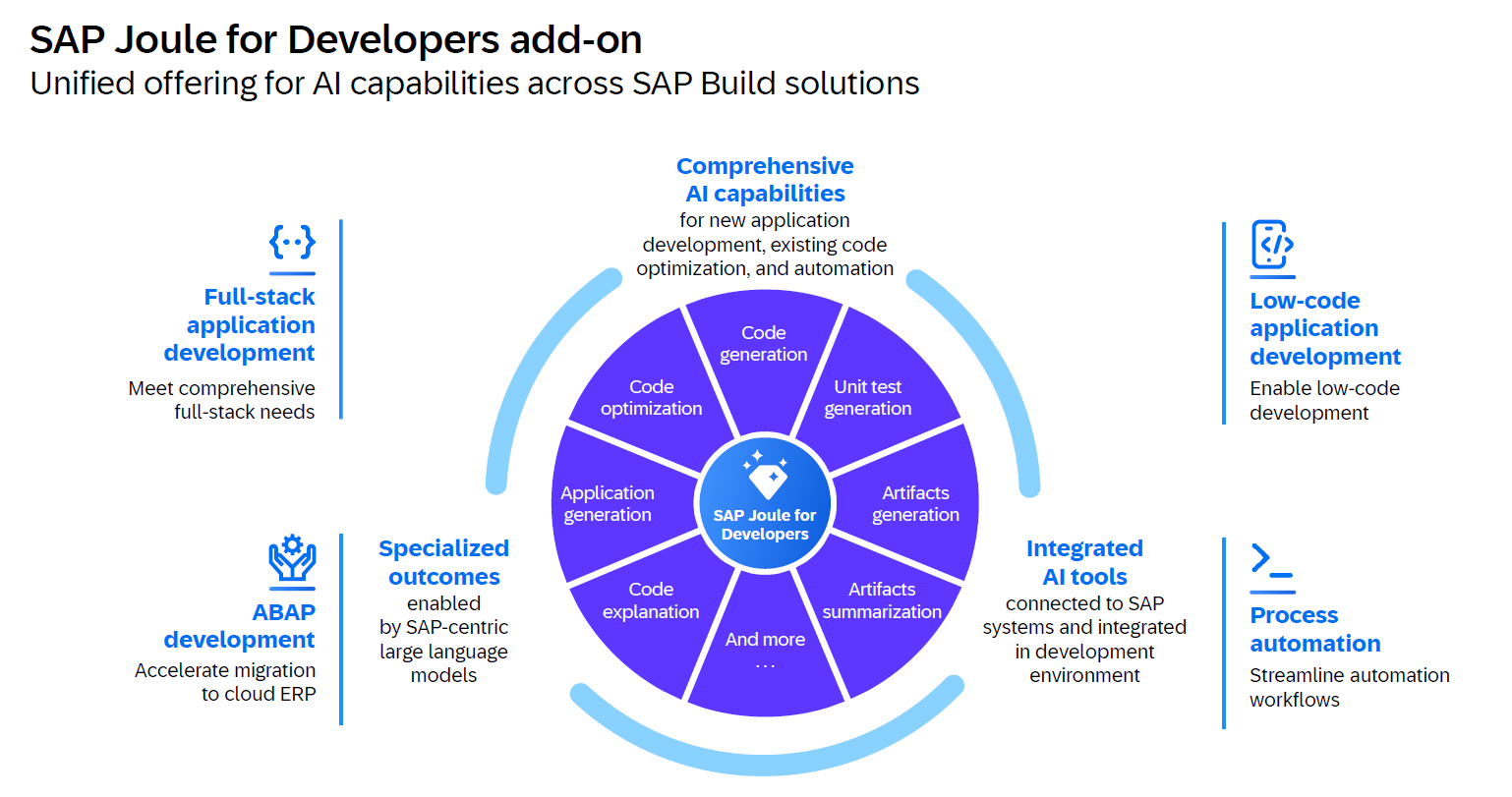
Source: SAP TechEd 2025 – AD104 – Boost your ABAP development with SAP Joule for Developers
For ABAP, the corresponding component is officially referred to as “SAP Joule for Developers, ABAP AI capabilities” and is natively integrated into Eclipse through ADT. From the authors’ perspective, this is a fundamental advantage over alternative tools, as the development context (for example, a specific RAP object) can be integrated more effectively.
SAP distinguishes between three primary areas of AI support within the ABAP development environment as part of SAP Joule for Developers. In the following sections, you will find a description of these features, including their scope and intended use, as well as information regarding their availability. Please note that licensing requirements must also be clarified. Customers should refer to material 8019124, while partners should refer to 8019541.
- Accelerate
- The target group for this area is the ABAP developer and increasing their efficiency during their daily work. SAP supports the developer, for example, by:
- Interact with AI via the “Joule Copilot” window
- Generation of RAP business objects (BO’s) and services
- Generation of unit tests for ABAP classes and Core data services
- Explanation of existing (legacy) code
- Help with code snippets, code analysis, documentation, existing help content and code predictions (“predective code completion”)
- Features in the Accelerate context are available on SAP BTP ABAP Environment, SAP Cloud ERP and SAP Cloud ERP private 2025 (formerly SAP S/4HANA, private Cloud). Previous releases of SAP Cloud ERP private can consume the features side-by-side. According to the current status, the features are not available on-premise and this is not planned by SAP.
- The target group for this area is the ABAP developer and increasing their efficiency during their daily work. SAP supports the developer, for example, by:
- Transform
- The ABAP developer should be supported in migrating customer-owned code to ABAP Cloud and a Clean Core. Both existing code and messages from the ATC check are explained. In addition, the AI offers suggestions for adapting/transferring existing coding.
- According to current knowledge regarding SAP Cloud ERP private, the availability of the Transform use case is analogous to the Accelerate features.
- Empower
- This area covers the integration of AI into applications for end users. ABAP developers are responsible for implementing these capabilities. SAP provides the ABAP AI SDK through ISLM (Intelligent Scenario Lifecycle Management), enabling standardized access to the generative AI hub in SAP AI Core on SAP BTP.
- The Empower area is available on both SAP BTP ABAP Environment, SAP ERP Cloud (incl. private) and S/4HANA On-Premise via downport until release 2021 (for more information, see SAP Note 3513374).
An overview of the current roadmap as of SAP TechEd 2025 is shown in the following slide: 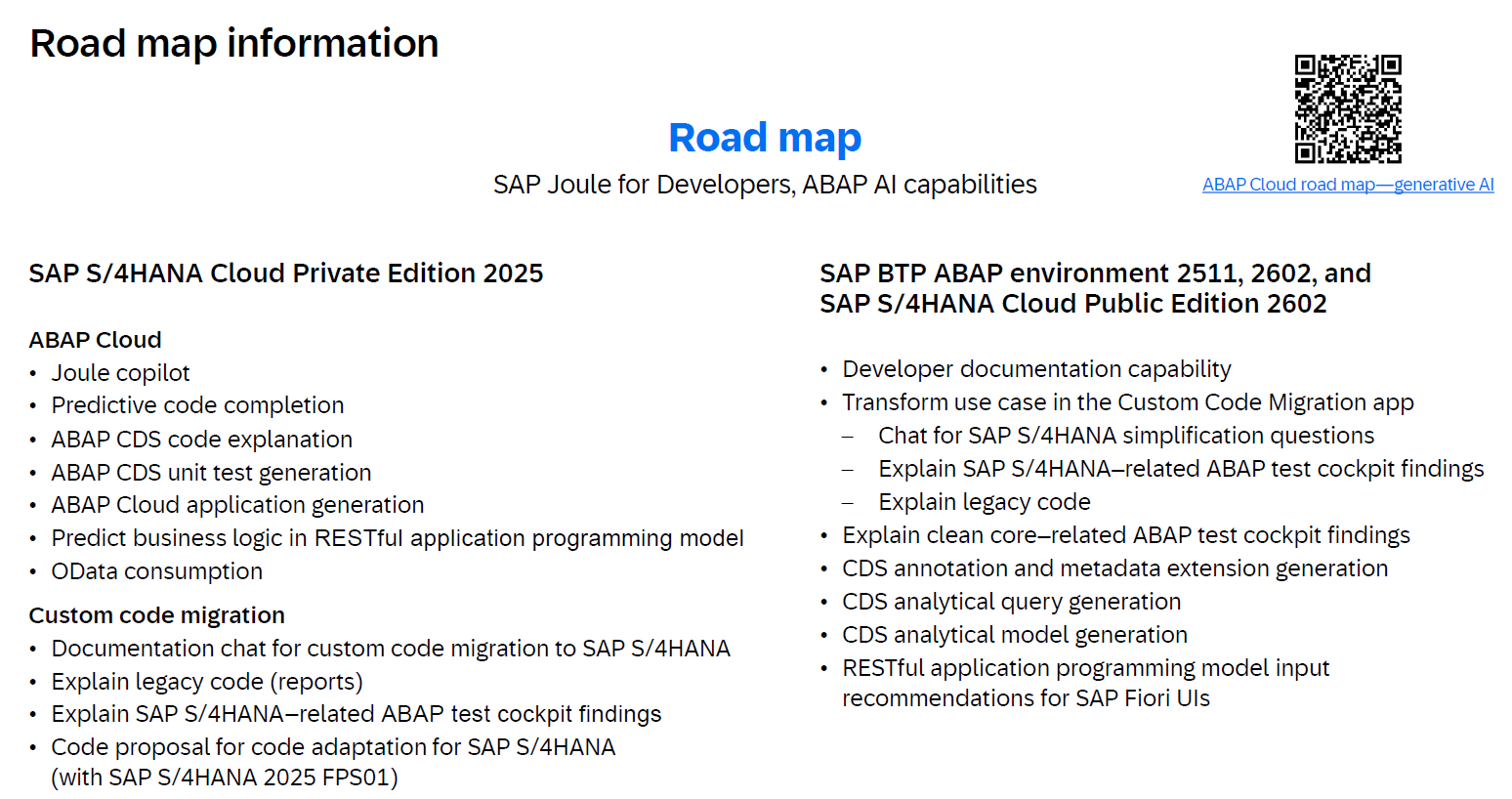
Current roadmap
Support for ABAP Development Through Alternative AI Tools
The use of official SAP tools such as “Joule for Developers” requires, as mentioned in the previous chapter, the use of cloud systems such as SAP BTP or at least operation in a private cloud environment in combination with the corresponding contracts. If you are working on a different SAP landscape, potential alternatives are available.
Using GitHub Copilot
For example, in March 2025 it was announced that GitHub Copilot is available in Eclipse and therefore ABAP also supports Introducing ABAP Support in GitHub Copilot for Eclipse.
You can find a good overview of this in the SAP community Getting Started with ABAP Support in GitHub Copilot.
Compared to the native SAP integration provided by Joule, the AI does not currently have automatic access to the full SAP context. Instead, the context must be explicitly provided through the Copilot chat window in ADT. This makes it particularly suitable for analyzing one or more classes within an application. GitHub Copilot offers the following capabilities:
-
Code Completion. As of the end of 2025, this feature can be used particularly helpfully for creating comments or as a somewhat smarter code completion. In any case, the proposed code fragments must be checked intensively for meaningfulness and correctness. Here, the quality of the results depends heavily on the use of Clean code. The more understandable and readable the code is and the more explanatory line comments are, the more likely the AI is to understand the context and the more useful the suggestions can be generated. Therefore, this function primarily increases the efficiency of very experienced developers who can immediately recognize the usefulness of suggestions and whose code has the necessary quality properties.
-
Code Explanation / Code Review Code artifacts listed in context can be explained by Copilot to gain a better understanding of the function. As an extension, Copilot can carry out a review of one or more code artifacts and thus take on a quality assurance task, which in turn relieves the developer’s workload. The success factors here lie in good “prompt engineering” by the user. The knowledge gained can be used to identify deficits and weak points in the code, to determine its quality level and finally to derive measures for training and further education of the developers.
-
Improvement of code While the review focuses on the understanding and quality level of the application or individual classes, Copilot can also be used to improve individual parts of the code. An example here is the optimization of a complex If-Else-Endif section with replacement by new statements or summary of error handling in try-catch blocks. A check of the improvement can then be carried out through prompting. In addition to the syntax check, Copilot not only provides statements about correctness but also an explanation as to why the correctness is given.
-
Other aspects In addition to the points mentioned, Copilot offers further support in creating unit tests or troubleshooting. In addition to chat, which does not make any changes to the code, there is also an agent mode that creates or changes code, similar to Joule. Since ongoing changes and improvements are to be expected here, we refer you to the official documentation at this point.
-
Custom Instructions An important function is the custom instructions. A prompt can be stored here in the Copilot settings, which contains basic definitions and instructions that are part of every prompt transmitted in the chat window. In this way, specifications for reviews, analyzes etc. can be simplified because generally applicable specifications are defined in the “Custom instruction prompt”.
Although GitHub Copilot does not offer the same level of deep integration as Joule, it can nevertheless be a valuable tool for helping skilled developers work faster and more effectively. It can also support quality assurance roles, such as lead developers, by enabling them to gain a deeper understanding of applications in less time. Based on these insights, targeted actions such as code corrections or developer training initiatives can be derived.
More alternatives
We would like to mention at this point that GitHub Copilot represents *a” possible alternative to SAP Joule for Developers - other options exist and are continually being created, including Amazon Q Developer. We as authors make no claim to completeness at this point and have selected Github Copilot to show you another option in more detail.
As with “Joule for Developers”, all AI results must be validated by the developer. The responsibility for accuracy lies with the user of the AI tool. Therefore, on the one hand, it must be ensured that employees have been appropriately trained and sensitized. In addition, potential processes can be established to ensure that AI-generated results cannot be used unchecked (keyword “human-in-command” or “human-in-the-loop”).
Additional Use Cases for Generative AI in Software Development
In addition to the opportunities described for increasing efficiency during the implementation phase, AI can also be applied in other phases of the software development lifecycle. Using several examples, we would like to illustrate areas in which generative AI can already provide support today and the benefits that can be achieved. Because a wide variety of tools exist and the questions discussed earlier may lead different organizations to choose different solutions and vendors, we intentionally avoid naming specific tools. Instead, we focus on describing use cases and providing inspiration for integrating chat-based AI tools into development activities.
AI for creating, checking and preparing customer requirements
AI is particularly suitable for text creation, checking and preparation. Good applications are based on well-defined requirements. In order to obtain good requirements, you can analyze requirements created by specialist users that exist or are to be created in a structured form using AI tools, check them for logic and consistency and, if necessary, have them prepared and structured. The power of AI can help you here, even without SAP integration, to put the basis for software development on a stable foundation.
AI as a tool for documentation creation
One practical use case is the assisted creation of documentation for custom developments. Currently available chat-based tools can be used by developers or responsible team members to create technical documentation for an application. To do this, the generative AI must be provided with the task (for example, “Create technical documentation”), the application context, and the purpose of the application. For the technical details, the code of the key classes containing the business logic, along with supplementary information, is transferred to the chat-based tool. Data protection requirements and potential confidentiality considerations must be taken into account.
If explanatory comments or, ideally, ABAP Doc documentation are already present within the codebase, the generative AI can use this information when creating documentation. Better results are generally achieved when Clean Code principles have been applied during development, since clean, readable, and human-understandable code can also be analyzed more effectively by AI systems.
The result of this approach is a description generated from the AI-based analysis of the available code information. This often makes it immediately apparent whether the code implements the intended logic in an understandable way and where manual corrections or additions may be required. With effective prompt engineering and iterative prompting (or fine-tuning of the generated documentation), a strong foundation can be created that can then be finalized through manual editing. The resulting documentation can subsequently be reviewed by the AI, providing further insights into its quality.
The primary goal is not to obtain fully automated documentation. Rather, the process helps create, revise, and finalize draft documentation, thereby improving quality while reducing the amount of manual writing required. Key success and efficiency factors include the quality and structure of the code base, experience with prompt engineering, and a solid understanding of the application being documented.
AI development on the SAP BTP beyond ABAP
Significant progress is also being made in AI development beyond ABAP. For example, SAP already enables numerous AI-powered capabilities to be integrated through VS Code for SAP Fiori (SAPUI5) and the Cloud Application Programming Model (CAP). With official ABAP support in VS Code planned for the second half of 2026, further developments in AI integration for ABAP are also expected.
Regardless of the implementation tools used with established technologies, SAP provides Joule Studio on SAP BTP, enabling the development of Joule Skills and their combination into powerful agent-based solutions. These Joule Skills frequently consume APIs from backend systems, many of which are implemented using ABAP. In this context, ABAP will therefore continue to accompany us—at least indirectly—for the foreseeable future.
Summary (AI-assisted)
AI will fundamentally transform application development in the SAP ecosystem. It will not replace developers; rather, it will support their strengths and reduce routine tasks. Those who make responsible use of the opportunities and capabilities offered by generative AI can achieve gains in efficiency and quality without diminishing their own expertise. Sound technical knowledge, good architecture, clean design, and critical thinking remain the foundation of all software development—both now and in the age of AI. The decisive factor is that humans retain control over the outcome and remain responsible for it.
This summary was created with the support of generative AI. It was, of course, carefully reviewed, revised, finalized by the author, and linguistically refined with the assistance of AI.